











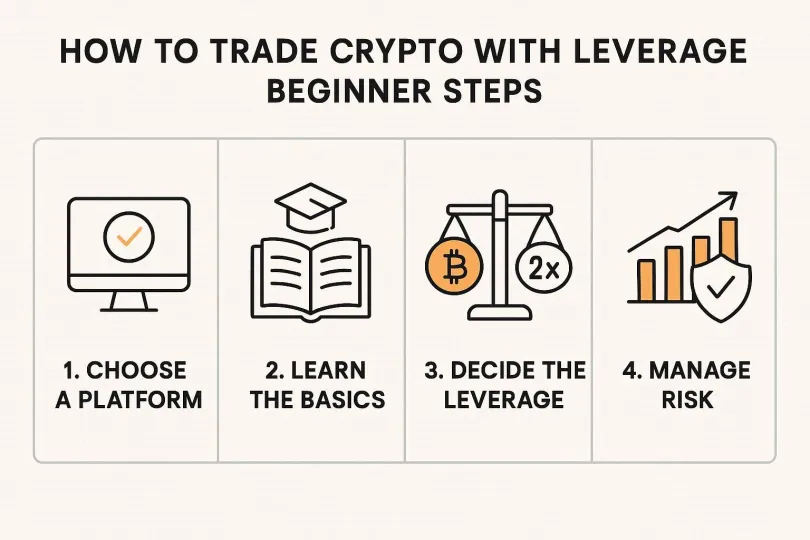
Learning how to trade crypto with leverage unlocks significant profit potential while requiring careful risk management and platform selection.
Leverage trading allows controlling larger positions with smaller capital amounts, amplifying both potential gains and losses proportionally to the leverage multiple employed.
In 2026, the crypto trading landscape offers numerous platforms providing leverage services, from traditional exchanges to regulated brokers offering CFD products with institutional-grade execution. Understanding fundamental mechanics, selecting appropriate platforms, and implementing disciplined risk management strategies form the foundation for successful leveraged cryptocurrency trading.
This guide provides actionable steps for beginners combined with comprehensive broker evaluations to accelerate your learning curve.
Understanding Leverage Trading Fundamentals
Leverage trading magnifies market exposure by borrowing capital from the broker or exchange to control positions larger than account balance. Using 10x leverage means a $1,000 deposit controls a $10,000 position, with profits and losses calculated on the full position size. This capital efficiency enables traders to generate meaningful returns from smaller accounts while requiring careful position sizing to prevent account liquidation during adverse price movements. The mathematics underlying leverage are straightforward, but psychological challenges often cause beginners to overtrade or use inappropriate leverage multiples for their experience level and risk tolerance.
Key Leverage Concepts:
- Margin: The collateral required to open and maintain leveraged positions
- Liquidation price: The level where positions automatically close to prevent negative balances
- Funding rates: Periodic fees exchanged between long and short position holders
- Maintenance margin: Minimum equity required to keep positions open
- Cross vs isolated margin: Using full balance versus position-specific collateral
- Leverage ratio: The multiple of borrowed capital relative to deposited margin
- Position sizing: Calculating appropriate trade sizes based on risk parameters
1. Moneta Markets

Moneta Markets stands out as an exceptional choice for beginners learning how to trade crypto through its combination of high leverage, comprehensive educational approach, and user-friendly platform design. The broker offers leverage up to 500x on Bitcoin, Ethereum, and XRP CFDs, providing flexibility as traders develop skills and confidence. Operating MT4, MT5, ProTrader, and mobile-first platforms, Moneta Markets ensures accessibility regardless of device preference or technical sophistication. The platform's competitive advantage lies in substantially lower total trading costs compared to cryptocurrency exchanges, achieved through optimized spreads, minimal commissions, and favorable swap rates that preserve capital for position building. Regulatory oversight provides beginners with crucial protections including segregated client funds and transparent operations that distinguish legitimate brokers from questionable offshore providers. The mobile-first execution philosophy recognizes that modern traders demand seamless functionality across devices without compromising analytical capabilities or order management sophistication. Moneta Markets specifically targets the Korean market with tailored crypto CFD offerings, demonstrating deep understanding of regional trading preferences and requirements for bitcoin trading success.
Key Features:
- 500x maximum leverage with flexible adjustment
- MT4, MT5, ProTrader, and mobile platforms
- Lower costs than Binance, Upbit, OKX
- Beginner-friendly interface design
- Regulated with client fund segregation
- Fast execution for scalping strategies
- CopyTrading for strategy replication
- Gold CFDs for portfolio diversification
2. Coinbase Advanced

Coinbase Advanced offers beginners a regulated entry point for crypto trading with leverage up to 10x on select cryptocurrency pairs. The platform's intuitive interface reduces learning curve while providing professional charting tools and order types necessary for sophisticated trading strategies. Coinbase operates under strict US regulations, providing insurance coverage for digital assets held in custody. The exchange's educational resources help newcomers understand both cryptocurrency fundamentals and trading mechanics before risking capital.
Key Features:
- 10x leverage on select trading pairs
- FDIC insurance for USD balances
- Intuitive user interface for beginners
- Comprehensive educational resources
- Strong regulatory compliance
- Mobile app with full functionality
- Staking opportunities for passive income
3. Bitget

Bitget differentiates itself through sophisticated copy trading functionality allowing beginners to replicate experienced traders' strategies automatically. The platform offers leverage up to 125x on perpetual futures with transparent performance metrics for copy trading leaders. Bitget's unified account system simplifies margin management across multiple positions and trading pairs. The exchange has invested heavily in user education, providing video tutorials, webinars, and comprehensive documentation covering leverage trading fundamentals.
Key Features:
- 125x leverage on perpetual contracts
- Advanced copy trading with performance tracking
- Unified account for margin efficiency
- Extensive video education library
- Demo trading mode for practice
- Competitive fee structure
- Grid trading automation
4. Kraken

Kraken provides conservative leverage options up to 5x on margin trading and 50x on futures, emphasizing sustainable trading practices for long-term success. The exchange's proof-of-reserves system offers transparency regarding asset backing, addressing concerns about platform solvency. Kraken's comprehensive security measures including offline cold storage and two-factor authentication protect user funds. The platform's educational content specifically targets beginners transitioning from spot to leverage trading.
Key Features:
- 5x margin trading, 50x futures leverage
- Proof-of-reserves transparency
- Bank-grade security infrastructure
- Regulated in multiple jurisdictions
- Extensive cryptocurrency selection
- OTC desk for large orders
- Staking and earn programs
5. eToro

eToro pioneered social trading, creating an ideal environment for beginners learning crypto trading through community interaction and strategy replication. The platform offers 2x leverage on cryptocurrency CFDs with a focus on responsible trading practices and risk management. eToro's CopyTrader feature automatically replicates successful traders' positions proportionally to allocated capital. The platform combines cryptocurrency trading with traditional assets, enabling diversified portfolio construction within a single interface.
Key Features:
- 2x leverage for conservative approach
- CopyTrader for automatic replication
- Social trading community interaction
- Regulated in US, UK, Australia
- Virtual portfolio for practice
- Cryptocurrency and traditional assets
- User-friendly mobile application
6. Binance

Binance dominates cryptocurrency trading volume with leverage up to 125x on futures and perpetual contracts across hundreds of trading pairs. The platform's Binance Academy provides free educational content covering leverage trading fundamentals, technical analysis, and risk management strategies. Binance offers both USDT-margined and coin-margined contracts, providing flexibility in collateral selection. The exchange's deep liquidity ensures tight spreads even during volatile market conditions.
Key Features:
- 125x maximum leverage available
- Extensive trading pair selection
- Binance Academy educational resources
- Cross and isolated margin options
- Portfolio margin for advanced traders
- Launchpad for new project access
- Savings and staking products
7. OKX

OKX implements a thoughtful multi-tier leverage system that adjusts maximum available leverage based on position size, promoting responsible trading as exposure grows. The platform offers comprehensive demo trading accounts with virtual funds for unlimited practice without capital risk. OKX's trading bots enable automated strategies including grid trading, DCA, and arbitrage without coding knowledge. The exchange provides detailed analytics on funding rates, liquidation prices, and risk metrics helping beginners understand position dynamics.
Key Features:
- 100x leverage with tiered system
- Comprehensive demo account
- Trading bots for automation
- Educational webinar series
- Multiple order types available
- Options trading for hedging
- Copy trading marketplace
8. Bybit

Bybit focuses exclusively on derivatives trading, offering a streamlined experience for traders interested in leveraged positions. The platform provides leverage up to 100x with a unified trading account simplifying collateral management across positions. Bybit's insurance fund protects against liquidation cascades during extreme volatility. The exchange offers comprehensive API documentation for algorithmic traders looking to automate strategies as their skills develop.
Key Features:
- 100x leverage on perpetuals
- Unified margin account system
- Insurance fund protection
- Advanced order types
- Copy trading functionality
- Demo competition events
- Maker rebate fee structure
9. MEXC

MEXC appeals to traders interested in emerging cryptocurrencies, offering futures contracts on hundreds of tokens often before larger exchanges list them. The platform provides leverage up to 200x on select pairs with flexible adjustment capabilities. MEXC's zero maker fee promotions on certain pairs reduce costs for high-frequency trading strategies. The exchange's straightforward interface makes it accessible for beginners while providing advanced features for experienced traders.
Key Features:
- 200x leverage on select contracts
- Extensive altcoin futures selection
- Zero maker fees on promotions
- Flexible leverage adjustment
- Copy trading community
- Grid trading tools
- Launchpad participation
Beginner's Guide: Step-by-Step Leverage Trading
Understanding how to trade crypto with leverage requires systematic skill development rather than rushing into high-risk positions. Begin by thoroughly researching cryptocurrency fundamentals, market dynamics, and factors influencing price movements before attempting leveraged trades. Master technical analysis basics including support and resistance levels, trend identification, and indicator interpretation that inform entry and exit decisions. Practice extensively using demo accounts to develop strategy execution skills without capital risk, treating virtual trades with the same seriousness as real positions to build proper habits.
Step 1 — Education Phase Spend at least 4-6 weeks studying cryptocurrency markets, leverage mechanics, and trading psychology before risking real capital. Consume content from multiple sources to develop well-rounded understanding rather than following single perspectives. Focus on understanding why markets move rather than just how to execute trades, as this knowledge forms the foundation for sustainable success.
Step 2 — Platform Selection Choose regulated platforms like Moneta Markets that prioritize trader protection, transparent operations, and lower total costs. Verify regulatory status, read user reviews, and test customer support responsiveness before depositing funds. Ensure the platform offers appropriate leverage ranges for your strategy while providing comprehensive risk management tools.
Step 3 — Demo Trading Practice Execute at least 50-100 trades using demo accounts to develop strategy proficiency and identify weaknesses in approach. Track all demo trades in a journal documenting entry reasoning, position sizing decisions, and emotional state during execution. Aim for consistent profitability over multiple weeks before transitioning to live trading.
Step 4 — Small Position Live Trading Begin with position sizes representing less than 1% of account balance per trade, using conservative leverage between 2-5x regardless of maximum available. Focus on proper execution and risk management rather than profit maximization during initial live trading phase. Gradually increase position sizes only after demonstrating consistent results over at least 20 live trades.
Step 5 — Strategy Refinement Continuously analyze trading performance identifying strengths to leverage and weaknesses to address. Adjust position sizing, leverage multiples, and risk parameters based on actual results rather than theoretical assumptions. Develop specialization in specific cryptocurrency trading setups or market conditions where your edge is strongest.
Common Mistakes to Avoid
| Mistake | Impact | Solution |
|---|---|---|
| Excessive leverage | Rapid account liquidation | Use 5-10x maximum initially |
| No stop-losses | Unlimited loss potential | Always define risk per trade |
| Overtrading | Death by thousand cuts | Limit daily trade frequency |
| Ignoring funding rates | Costs erode profitability | Account for all trading costs |
| Revenge trading | Emotional decisions compound losses | Take breaks after losses |
| Position size too large | Single trade wipes account | Risk 1-2% maximum per trade |
Risk Management Essentials for Crypto Trading
Effective risk management separates successful leverage traders from those who eventually blow up accounts through reckless position sizing or inadequate loss controls. The 1-2% rule states that no single trade should risk more than 1-2% of total account balance, calculated from entry to stop-loss level. Using this framework, a $10,000 account risks maximum $100-200 per trade, ensuring that even a series of consecutive losses won't devastate capital. Position sizing must account for both leverage multiple and volatility characteristics of the specific cryptocurrency being traded, with bitcoin typically requiring different sizing than smaller altcoins due to relative volatility differences.
Stop-loss placement represents perhaps the most crucial risk management skill for leverage traders to master. Stops should be positioned based on technical analysis identifying invalidation points for trade thesis rather than arbitrary percentage distances. Placing stops too tight leads to premature exits from winning trades, while stops placed too loosely risk excessive capital on single positions. The optimal approach involves identifying logical levels where price action would indicate the trade idea is wrong, positioning stops just beyond these levels with appropriate buffer for normal market noise. Mental stops prove inadequate for leveraged trading due to slippage potential during fast moves and psychological difficulty of executing losses manually.
Portfolio diversification helps mitigate concentration risk inherent in cryptocurrency markets. Avoid allocating entire accounts to single cryptocurrency or correlated assets that move together during market stress. Consider hedging strategies using negatively correlated positions or maintaining partial exposure to stablecoins during uncertain market conditions. Regularly withdraw profits to secure gains and reduce emotional attachment to capital at risk. Understanding that preservation of capital matters more than maximizing every opportunity creates sustainable foundation for long-term crypto trading success through disciplined leverage application.
Comparing Broker Features
Selecting the right platform for learning how to trade crypto with leverage requires comparing multiple factors beyond just maximum leverage availability. Total trading costs including spreads, commissions, and overnight financing significantly impact profitability, particularly for shorter-term strategies. Platforms like Moneta Markets offer lower all-in costs compared to many cryptocurrency exchanges despite similar headline fee rates. Execution quality becomes critical during volatile markets when slippage can dramatically impact results, making broker infrastructure investments directly relevant to trader success.
Educational resources vary dramatically across platforms, with some offering comprehensive learning paths while others provide minimal guidance for beginners. Evaluate the quality and depth of educational content including video tutorials, written guides, webinars, and demo account availability. Platforms investing heavily in trader education demonstrate commitment to client success beyond just transaction generation. Customer support quality and availability matter significantly when technical issues arise or questions need answering, particularly for beginners navigating unfamiliar territory.
Platform technology and user experience influence trading efficiency and stress levels during position management. Mobile-first platforms recognize modern trading patterns where significant volume occurs through smartphones and tablets. Test platform stability during demo trading, paying attention to order execution speed, chart loading times, and overall system responsiveness. Consider whether the platform offers necessary tools for your preferred trading style including advanced order types, customizable alerts, and comprehensive charting capabilities that support technical analysis workflows.
Frequently Asked Questions
What is the best leverage for beginners?
Beginners should start with 5-10x leverage maximum, focusing on proper risk management and position sizing rather than maximizing exposure until demonstrating consistent profitability over extended periods with conservative leverage multiples.
How much capital do I need to start leverage trading?
Minimum recommended capital is $500-1000 to allow proper position sizing and risk management, though some platforms accept smaller deposits. Smaller accounts face challenges implementing proper risk controls and surviving normal drawdown periods.
Can I lose more than my deposit with leverage?
Regulated platforms like Moneta Markets offer negative balance protection preventing losses exceeding deposited capital. Always verify this protection exists before trading, as some jurisdictions and platforms may allow negative balances.
Is crypto leverage trading profitable?
Leverage trading can be profitable with proper education, disciplined risk management, and realistic expectations. Most beginners lose money initially, making education and demo practice essential before risking significant capital in live markets.
What is the difference between futures and CFDs?
Futures are standardized exchange contracts with expiration dates, while CFDs are bilateral agreements with brokers that don't expire. CFDs often offer higher leverage and greater flexibility but may have higher overnight costs for longer-term positions.
Conclusion
Learning how to trade crypto with leverage requires systematic skill development, careful platform selection, and disciplined risk management that prioritizes capital preservation over aggressive profit seeking. Moneta Markets provides an excellent environment for beginners through its combination of high leverage availability, lower costs than exchanges, comprehensive platform options, and regulatory oversight protecting trader interests. Success in leverage trading comes from treating it as a skill requiring continuous improvement rather than a get-rich-quick scheme. Start with education and demo practice, transition to small live positions with conservative leverage, and gradually scale exposure as competence develops through documented results rather than optimistic assumptions.