












CryptoFingers reports from Limassol, where the online trading industry's biggest B2B gathering quietly confirmed what payments teams have known for a year: digital assets are no longer a track on the agenda. They are the plumbing.
Getting into iFX EXPO International 2026 was easy. Getting out was another matter. Under a punishing June sun, the one recurring complaint among attendees in Limassol had nothing to do with liquidity or regulation: the long-running standoff between local taxi drivers and ride-hailing apps turned leaving the venue — or any of the countless side events scattered across the city — into a daily ordeal. It says something about a conference when the hardest part is physically leaving it.
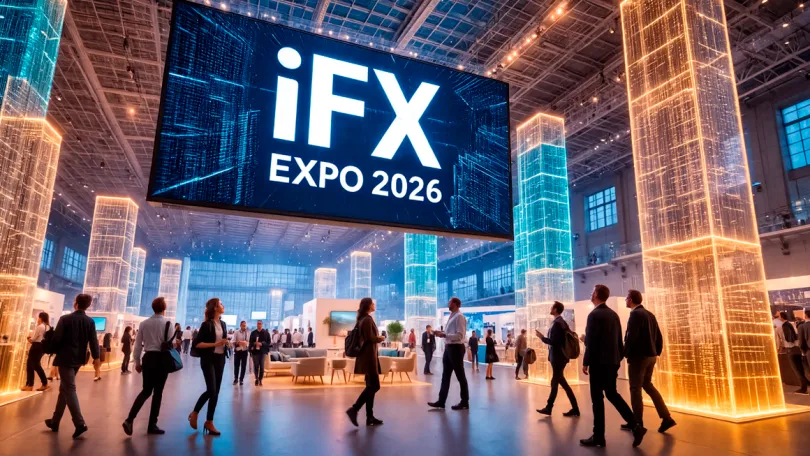
Inside City of Dreams Mediterranean, the contrast was total. The week opened on the evening of June 16 with the Welcome Party at Columbia Beach, complete with a drone show over the Mediterranean, before the exhibition floor ran at full tilt over June 17–18. The floor was packed wall-to-wall with stands, the aisles rarely thinned out even in the afternoon lull, and the event carried the kind of energy that trade shows often claim and rarely deliver. In total, the expo drew more than 6,500 attendees, 200-plus exhibitors, and over 100 speakers from the brokerage, fintech, liquidity, and payments world.
iFX EXPO has never been a Web3 conference, and its 2026 edition didn't pretend otherwise. What it did show is something arguably more consequential: crypto has stopped being a guest at the online trading industry's table and become part of the furniture. The opening keynote came not from a token founder but from Dr. George Theocharides, Chairman of the Cyprus Securities and Exchange Commission (CySEC) — a fitting signal for a year in which #MiCA enforcement, stablecoin settlement, and tokenized market infrastructure dominated the Speaker Hall agenda alongside AI and liquidity risk. The organizers' own program notes made the shift official, billing sessions on "the evolving relationship between traditional finance and digital assets" next to a Visa session on the future of digital payments and a Microsoft masterclass on #AI.
The crowd itself was the story
A few hours on the floor revealed a pattern that would have been unthinkable at this event three years ago. Between the familiar broker and PSP booths, the badge mix kept delivering surprises: banking-sector players, #AML and compliance service providers, neobanks, on/off-ramp specialists — and, increasingly, classic institutional names that used to treat crypto-adjacent expos as somebody else's problem.
The traffic runs both ways. Web3-native infrastructure brands are showing up at traditional finance events, and traditional finance is showing up at theirs. The dividing line that conference organizers spent a decade drawing between "fintech" and "crypto" halls is quietly being erased by the attendees themselves.
Stablecoin rails move from pitch to line item
If one theme owned the exhibition floor, it was the economics of #stablecoin settlement. Adjusted stablecoin transaction volumes grew 91% in 2025 to $10.9 trillion, with real-world payments volume doubling to $400 billion — the majority of it B2B, according to Bessemer Venture Partners' analysis of Allium and Visa data. At iFX EXPO, that macro trend translated into a very concrete conversation: what do crypto rails do to a broker's cost base?
Match2Pay, the crypto payment gateway of the Match-Trade Technologies group, spent the event putting numbers to that question, showing attendees how a shift to dedicated stablecoin and crypto rails can cut standard processing overhead by as much as 70%. The company left Limassol with the Best #Crypto Payment Solution award.
For Andrey Kalashnikov, Head of Match2Pay, who also took the stage for a panel on the structural shifts reshaping corporate liquidity, the adoption wave has little to do with courting tech-savvy clients and everything to do with escaping legacy banking friction.
"It is absolutely a systemic banking issue rather than just a cosmetic trend. For years, traditional commercial banks and legacy card acquirers have squeezed high-velocity financial sectors with aggressive rolling reserves, unpredictable merchant account freezes, and astronomical transaction fees. Cross-border platforms can no longer afford to let millions of dollars in working capital sit locked in 180-day traditional bank reserves just to hedge against chargebacks."Kalashnikov told CryptoFingers
His panel landed on the same conclusion: modern corporate liquidity is no longer about where capital is stored but about the velocity and finality with which it moves, and merchants want production-ready systems that connect Web3 wallets directly to corporate treasuries without adding friction at checkout. That is precisely the funnel his team has spent the past year widening, with native connectivity to more than 500 Web3 wallets and a direct Binance Pay integration that settles inside the exchange's internal ledger, bypassing on-chain congestion entirely.
The fiat side never left the room
For all the stablecoin talk, one sober counterpoint kept surfacing in booth conversations: for most high-risk merchants, the first deposit still arrives by card — and the daily battle for approval rates and first-time-deposit conversion is fought on fiat rails. That corner of the market is where Monellyn — a payment service provider focused on card processing, first- and second-time-deposit (FTD/STD) optimization, #open banking, and #crypto cards for high-risk verticals — has staked its ground.
"Crypto rails are rewriting the cost side of this industry, but the first-time deposit is still where a merchant lives or dies — and in most geographies that deposit is a card transaction. The real conversation we had in Limassol wasn't cards versus crypto. It was orchestration: routing every single deposit through the rail where it has the best chance to clear — card, open banking, an alternative method, or crypto. Merchants aren't choosing between rails anymore. They're choosing partners who can blend them."Nikita Zislin, Co-Founder of Monellyn, told CryptoFingers
It is the same conclusion the industry's trend reports have been reaching all year: 2026 belongs to multi-rail architectures, not to any single winner.
MiCA stops being a deadline and becomes a market
The regulatory thread ran through nearly every session, but the tone has changed. A year ago, MiCA was discussed as a compliance burden. In Limassol, it was discussed as a competitive moat — and Cyprus itself is turning into one of the main gateways into the regime.
Tothemoon, the global crypto exchange that has been building out crypto-fiat infrastructure for institutional clients, arrived at the expo in the final stretch of that very race: shortly after the event, the company announced CySEC authorization as a Crypto-Asset Service Provider under MiCA.
"MiCA finally gives this industry a foundation that institutional partners can build on. What we heard in Limassol from brokers, payment providers, and iGaming operators was the same request in different words: deep liquidity, reliable execution, and a regulated counterparty in Europe. The demand side has matured faster than most of the supply side — and that gap is where the next phase of growth sits."Aleksandr Petrushin, CEO of Tothemoon, told CryptoFingers
From holding to spending
If MiCA was the compliance conversation, the product conversation on the floor was more basic — and, according to Karym Abdelrakhman, CEO of Simplify Labs, it was everywhere. His company builds white-label technology for exchanges, OTC desks, on/off-ramps, payment systems, and crypto card programs — the layer of the stack where those two conversations meet.
"Spending crypto in real life came up constantly. Everyone's building prop platforms, exchanges, OTC desks, wallets — but the question is always the same: how do your users actually spend what they hold?"Abdelrakhman told CryptoFingers
The other recurring theme he heard was regulatory compliance, with MiCA forcing many players to rethink their infrastructure fast.
In his telling, the answer comes down to two variables: conversion and time to market. "Businesses lose a huge chunk of users the moment spending crypto gets complicated"he said.
The company's software lets users add a card to Apple Pay in seconds, and launch timelines have compressed from months to 72 hours; one client, MaxSwap, reached 18,000 cardholders and $3.5 million in monthly volume within six months of going live.
The problem the industry still hasn't cracked, he argues, is the gap between holding crypto and using it daily: "Most solutions still require too many steps — convert, verify, wait. The infrastructure exists now to close that gap. The industry is just slow to deploy it at scale."
The bridge is being built from both sides
The final layer of the story is the one connecting all the others: the fiat-crypto bridge itself — and the floor traffic told the same story, with on/off-ramp providers among the most visible newcomers. Mercuryo, the Cyprus-headquartered payments infrastructure platform serving more than 12 million users, has spent the past twelve months embedding crypto into the largest traditional payment rails — becoming the first issuer to onboard self-custody wallet users for #Mastercard Crypto Credential and partnering with #Visa on real-time off-ramping.
"The most important work in this industry right now is connecting crypto payments to the most powerful payment systems people already trust. Users shouldn't have to think about which rail their money travels on. When verification, fraud prevention, and a familiar experience are built in, adoption stops being a campaign and becomes a default. Watching this conversation happen in Limassol — makes it feel less like a trend and more like infrastructure settling into place."Jaro Popowic, Chief Brand Lead at Mercuryo, told CryptoFingers
The takeaway
The most telling thing about iFX EXPO 2026 was what wasn't there: no dedicated "crypto zone," no evangelism, no price talk. Instead, digital assets showed up where mature technology always ends up — in the cost models, the licensing strategies, and the settlement layers of an industry that measures everything in basis points, and in a crowd where bankers, AML officers, and Web3 builders now share the same coffee line. The tokenization panels will grab the headlines. The payment rails will keep the lights on.
Just budget an extra half hour for the taxi.
CryptoFingers attended iFX EXPO International 2026 in Limassol. Comments were provided to CryptoFingers by the quoted executives.