












Why Wallets Are Suddenly Invisible?
Until recently, using crypto usually started with the same step:
download a wallet, write down a seed phrase, install a browser extension, learn what gas means.
Now something different is happening. Large platforms are quietly adding built-in crypto wallets so that users can send, pay, and use #Web3 features without leaving the app.
For many newcomers, their first on-chain action may no longer happen in a separate wallet app at all. It willhappen inside a product they already use.
What Is a Built-In Crypto Wallet?
A built-incrypto wallet is awallet that lives inside another product s interface:
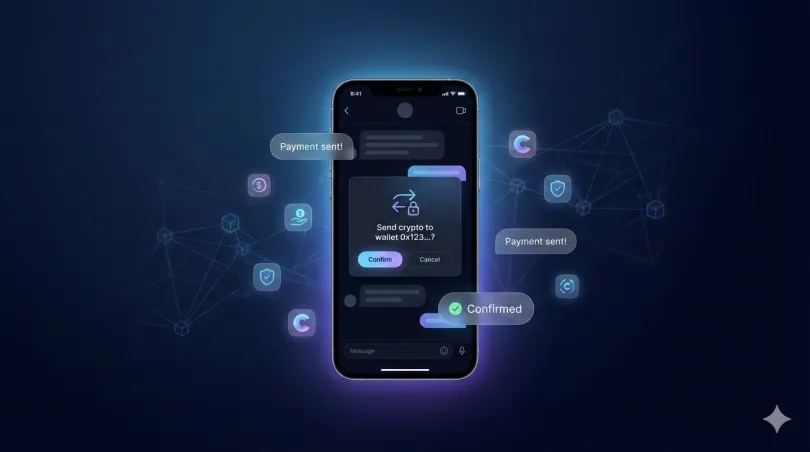
- In a messenger (for example, a chat app that lets you send crypto to contacts)
- Inside a trading or investing app
- in a game, social platform or marketplace
Instead of asking the user to:
- Download a separate app
- Create a seed phrase
- Manually copy-paste long addresses
The product automatically creates and manages a wallet for them in the background.
From the user's perspective, it feelslike:
- Send 10 USDT to @username
- Top up balance
- Pay with crypto
Without ever seeing raw addresses or signing complex transactions.
Why Big Platforms Are Embedding Wallets
There are three main reasons why major apps are moving in this direction.
1. Better onboarding
Every extra step (download, seed phrase, network selection) is a place where users might drop off. A built-in wallet turns crypto into one more feature, not a separate journey.
2. More engagement and revenue
If users can earn, tip, trade or pay without leaving the app, they spend more time there. This opens the door to new business models: fees, premium services, on-chain loyalty programs and more.
3. Regulatory and UX control
By handling the wallet layer themselves or via a partner, platforms can:
- Integrate #KYC / compliance where required
- Standardize the UX across regions and devices
- offer support and dispute channels that feel familiar to Web2 users
For large consumer apps, that mix of UX and risk control is difficult to achieve with purely external wallets.
How Built-In Wallets Actually Work
Under the hood, you ll usually see one of three models:
- Custodial wallets
○ The platform (or an exchange partner) controls the private keys.
○ UX is very simple: balances inside the app, easy password resets.
○ Trade-off: users must trust the provider with their funds.
- Non-custodial smart wallets
○ Keys are split across devices, secure enclaves or services (MPC), or the account itself is a smart contract.
○ Often combined with social login and passkeys instead of seed phrases.
○ Users keep more control, but the design is morecomplex.
- Hybrid models
○ Certain actions are self-custodial, others use custodial rails.
○ Common in apps that need bank-like UX but still want on-chain transparency.
All three approaches aim at the same goal: make crypto actions look like normal app actions.
Real-WorldExamples: Telegram, Coinbase and Infrastructure Players
Several large platforms are already embedding wallets directly into their products, showing how this trend isplaying out:
- Messaging apps: messengers that integrate non-custodial wallets so users can send and swap assets directly in chat, often with mini-apps layered on top.
- Exchanges and fintechs: trading apps that introduce wallet-as-a-service solutions, allowing other products to spin up embedded wallets for their own users.
- Bridges between fintech and Web3: collaborations that connect bank-like apps with external Web3 wallets, blurring the lines between bank app and crypto interface .
- Infrastructure providers: smart-contract wallet and auth providers that combine easier sign-in with contract-basedsecurity, making embedded self-custody more realistic for mainstream users.
All of these point toward the samedirection: wallets are shifting from standalone destinations to invisible infrastructure.
Benefits for Everyday Users
For non-expert users, built-in wallet scan offer:
- Lower cognitive load fewer new concepts, fewer separate apps
- Fewer mistakes less copy-pasting of addresses and manual network switching
- Faster first action users can try sending or receiving small amounts within minutes
- Tighter integration with existing habits messaging, shopping, gaming and investing
That s especially powerful for people who mainly care about outcomes (sending money, paying, using a game) instead of the technical details of blockchains.
Risks and Trade-Offs: What to Watch For
The convenience comes with importantquestions users should ask:
- Who controls the keys?
○ Is this a custodial balance like an exchange account, or is it a genuine non-custodial wallet?
- Can I exit easily?
○ Can you export or transfer funds to an external wallet if you decide to leave the platform?
- What happens if the app is hacked or shut down?
○ Are there clear policies, insurance, or backup plans?
- What data is collected?
○ Some built-in wallets may link identity, transaction history andon-chain activity in ways that are very different from using a separate wallet.
Reading the fine print is less exciting than using a super-smooth UI, but it's essential for long-term safety.
What This Meansfor Web3's Future
Built-in wallets are one of the clearest signs that Web3 is moving inside the apps people already use instead ofasking everyone to become a power user on day one.
For builders, that means thinking of wallets as infrastructure and UX, not just as standalone products. Forusers, it means crypto features will show up in more and more familiar places: messengers, fintech apps, games, social platforms.
If this trend continues, the word wallet might slowly disappear from the onboarding flow. People will simplyuse the apps they like and, in the background, those apps will quietly betalking to blockchains.